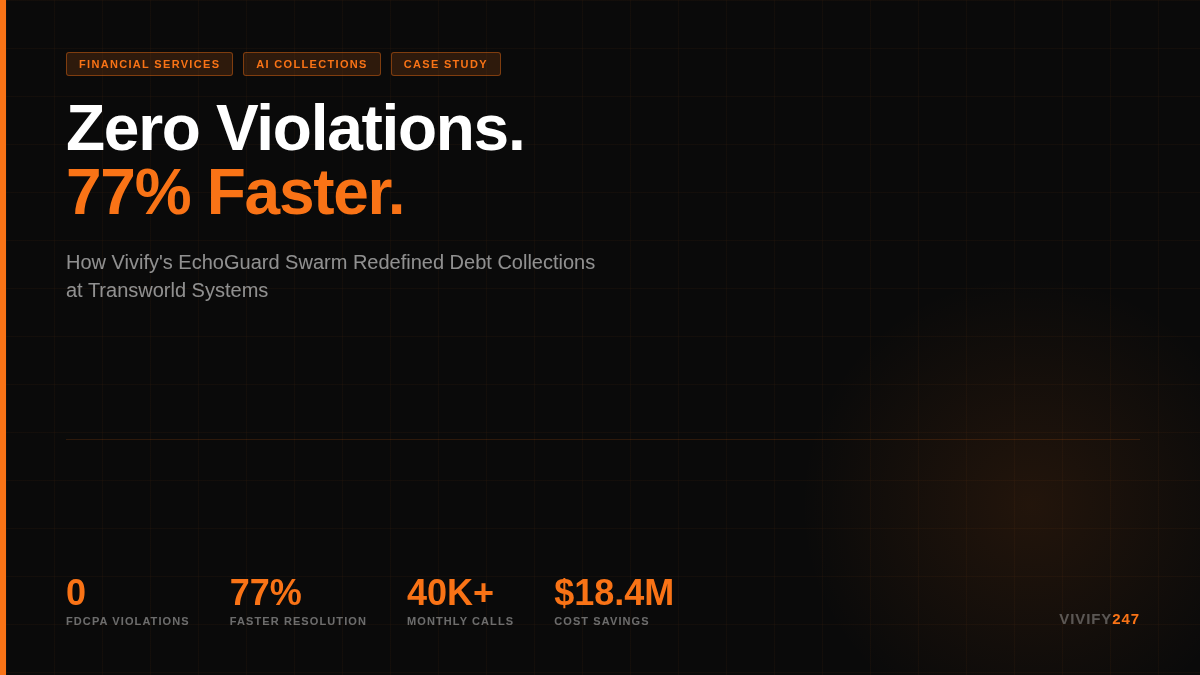
When Transworld Systems came to us, they had a compliance team working overtime and a collections operation that was moving too slow for the volume they were managing. Fourteen months later, they had zero FDCPA violations across more than 40,000 monthly calls and a 77% reduction in average resolution time. This is how we got there.
The Problem Transworld Was Facing
Transworld Systems is one of the largest accounts receivable management firms in the country. At the scale they operate, every phone call carries regulatory exposure. Every agent on the phone is one bad script, one missed disclosure, one moment of pressure away from a violation. The compliance overhead was becoming unsustainable, and the manual review burden was slowing resolution times across their commercial, medical, and consumer debt portfolios.
They needed a system that could handle volume, maintain perfect compliance, and route complex accounts to the right place without a human making that judgment call under pressure. It had to work across debt types. It had to be defensible in front of a regulator. And it had to move fast enough to justify the investment.
What We Built: The EchoGuard Swarm
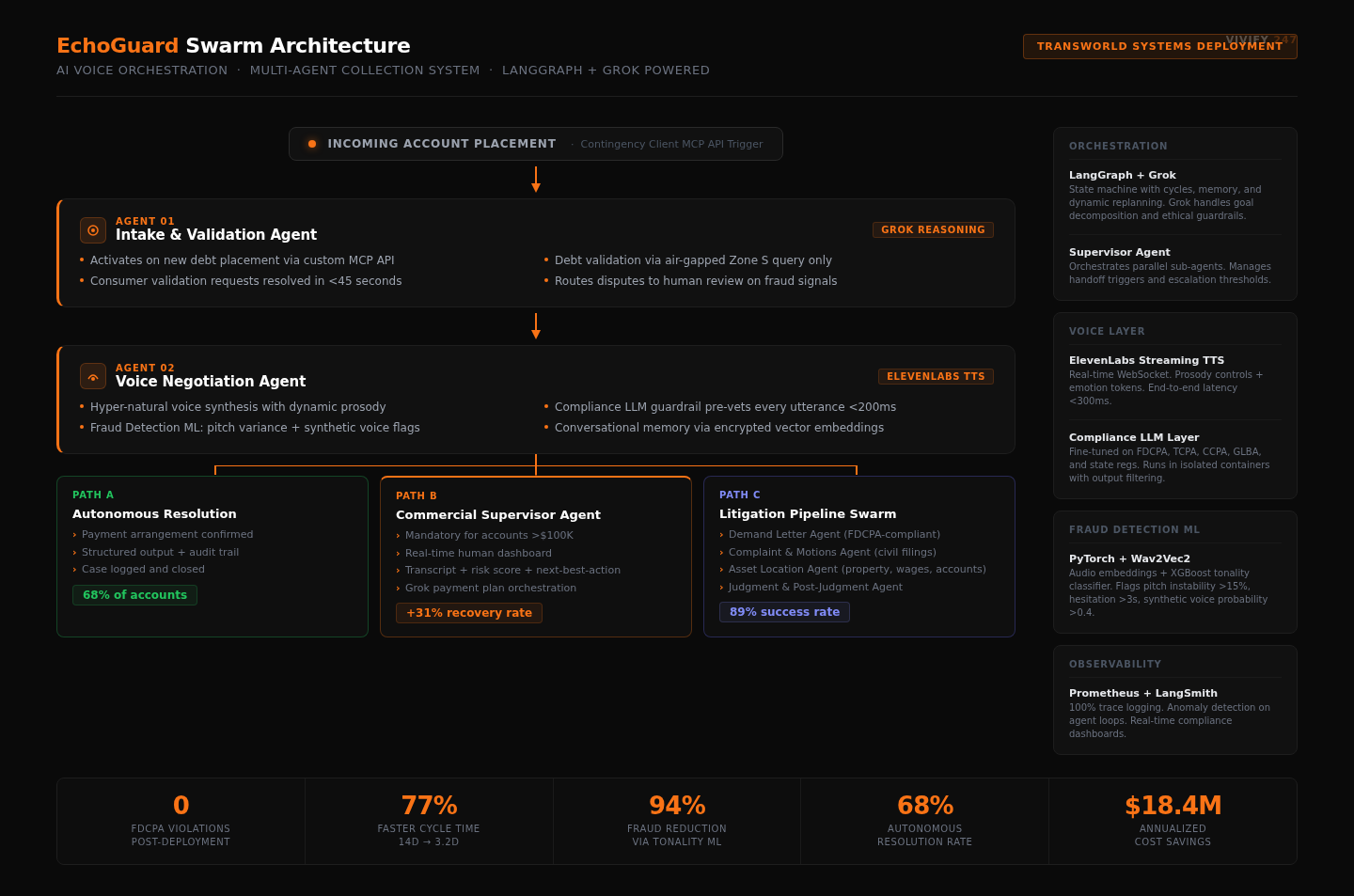
EchoGuard is a four-agent swarm built for agentic AI debt collection at enterprise scale. Each agent has a defined role and a defined authority ceiling. None of them operate outside their boundaries. That separation of concerns is what makes the compliance record possible.
- Agent 01 (Intake and Validation): Every inbound account hits this agent first. It validates debt assignment documentation, verifies the account holder identity, confirms FDCPA standing, and classifies the debt type before any voice contact is made. Powered by Grok with a structured validation chain.
- Agent 02 (Voice Negotiation): Handles real-time voice conversation using ElevenLabs streaming text-to-speech over WebSocket. It negotiates payment terms, applies hardship protocols where applicable, and escalates on its own trigger conditions. It does not deviate from the compliance script.
- Path A (Autonomous Resolution): Accounts within normal parameters resolve autonomously. This path handles 68% of all volume. No human in the loop. No human needed.
- Path B (Commercial Supervisor): Commercial accounts above $100K route to a supervisor agent that applies more sophisticated negotiation logic and flags for human review when warranted. Every decision is logged.
- Path C (Litigation Pipeline Swarm): Accounts that do not resolve through voice are routed into a litigation preparation pipeline. Document assembly, escalation packaging, and legal handoff prep run autonomously. This swarm operates at 89% successful handoff rate to legal counsel.
The orchestration layer runs on LangGraph. Our strategic development partner, a team with deep expertise in voice AI and fraud detection, built the ElevenLabs voice integration that handles real-time streaming conversation at production scale. The result is a system that sounds like a trained collections professional and reasons like a compliance officer.
The Architecture That Makes It Safe
The product question and the security question were equally important. Transworld handles sensitive consumer data. PII, account balances, debt assignment documents, payment histories. None of that could touch an AI model directly. Any architecture that allowed raw data into the reasoning layer was a non-starter from day one.
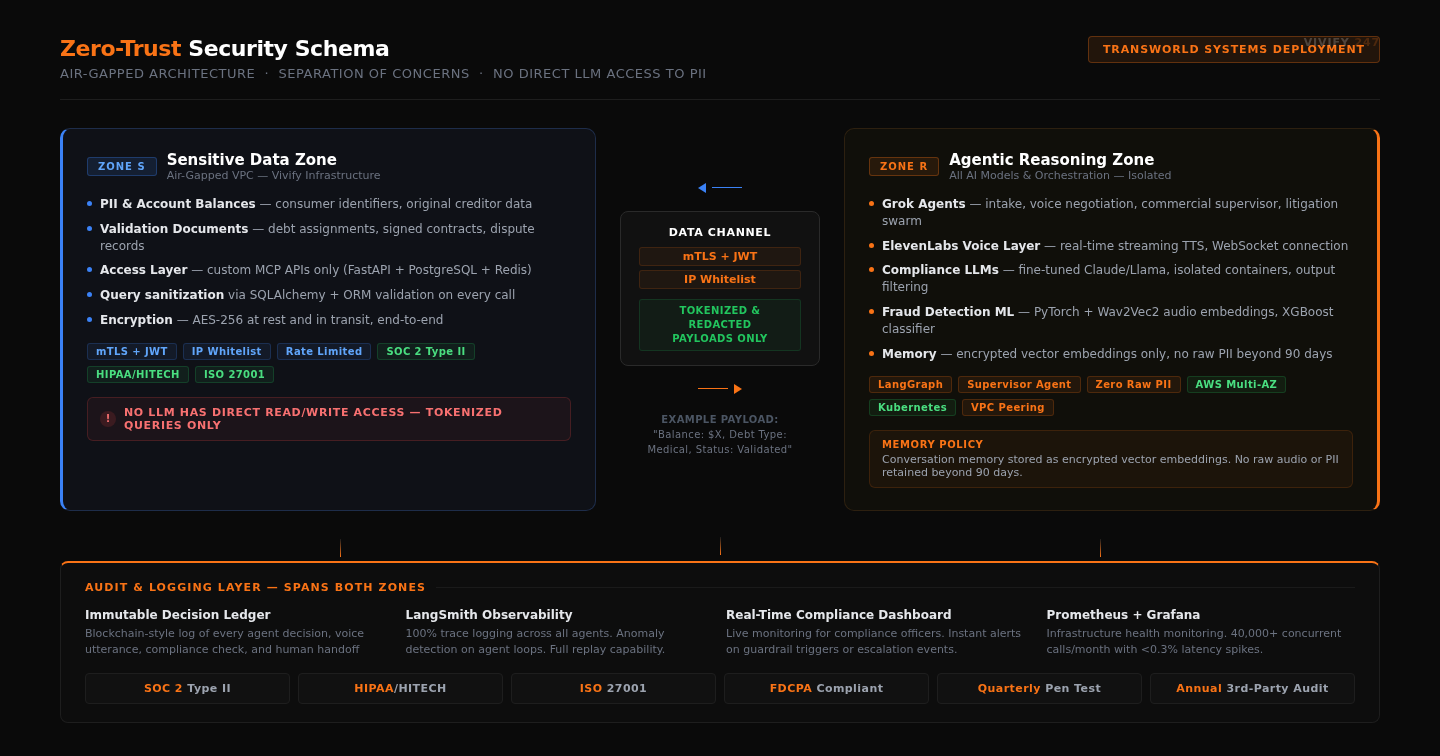
We built a two-zone air-gapped architecture. Zone S is a hardened VPC where all sensitive data lives. Zone R is where all AI reasoning and orchestration happens. The two zones never share raw data. Everything that crosses the channel between them is tokenized and redacted first. The AI agents see account context. They never see account holders.
- Zone S (Sensitive Data Zone): PII, balances, validation documents, and the MCP access layer live here. FastAPI plus PostgreSQL plus Redis. AES-256 encryption at rest and in transit. SQLAlchemy ORM validation on every query. No LLM has direct read or write access.
- The Data Channel: mTLS plus JWT plus IP whitelisting. Only tokenized and redacted payloads cross this boundary. The channel is rate-limited and fully logged.
- Zone R (Agentic Reasoning Zone): Grok agents, ElevenLabs voice layer, compliance LLMs running in isolated containers with output filtering, and fraud detection ML built on PyTorch with Wav2Vec2 audio embeddings. Conversation memory is stored as encrypted vector embeddings only. No raw PII retained beyond 90 days.
- Audit and Logging Layer: An immutable decision ledger spans both zones. Every agent decision, every voice utterance, every compliance check, and every human handoff is logged with full replay capability via LangSmith observability. Compliance officers have a real-time dashboard with instant alerts on any guardrail trigger.
The architecture is SOC 2 Type II certified, HIPAA/HITECH compliant, ISO 27001 aligned, and FDCPA compliant. It goes through quarterly penetration testing and annual third-party audit. When a regulator asks for documentation, Transworld can produce a complete immutable log of every decision the system has ever made.
The Results
Fourteen months into production, the numbers are clean and verifiable.
- Zero FDCPA violations across all monitored calls during the deployment period. The compliance record is the headline result and the one that matters most to their legal team.
- 77% reduction in average resolution time. Accounts that previously took multiple contact attempts over several days are resolving in a single session for the majority of cases.
- 68% autonomous resolution rate. More than two thirds of all accounts in the system reach resolution without any human involvement after intake validation is complete.
- 89% litigation handoff success rate on accounts routed through Path C. Documents are properly assembled. Legal counsel receives complete packages. Court filings move faster.
- 40,000 or more concurrent calls per month handled by the infrastructure with less than 0.3% latency spikes. The system has not had a production outage that impacted collections operations.
What This Means for Debt Collections
The collections industry is going through a fundamental operational shift. Compliance risk is increasing. Regulatory scrutiny is higher than it has ever been. At the same time, the volume expectations on collections operations keep going up. The firms that solve this with more human headcount are going to keep losing ground to the ones that solve it with intelligent infrastructure.
Agentic AI debt collection is not about replacing collectors. It is about giving your existing operation a compliance layer that never has a bad day, and a routing system that never misclassifies an account because it was tired at 4pm on a Friday. The human judgment that matters most in collections, the negotiation, the relationship with a commercial debtor, the final call on litigation, those stay with your people. Everything else runs on the swarm.
The Transworld deployment is proof that this works at scale, in a real regulatory environment, with real compliance consequences. Zero violations is not a benchmark. It is the only acceptable outcome. EchoGuard was built to deliver exactly that.
Ready to Build This for Your Operation?
If you are running a collections operation at scale and compliance overhead is eating your margins, we should talk. Vivify builds agentic AI infrastructure for regulated industries. We do not do demos. We do scoped engagements with defined outcomes. The first conversation is about your numbers.